

Why rail project tenders fail before technical review
Dr. Alistair Thorne
Time
Click Count
Many rail project tenders fail before technical review starts. The cause is rarely weak engineering alone. Early rejection usually comes from compliance gaps, incomplete bid files, distorted risk allocation, and poor commercial framing. In global transit procurement, these failures can eliminate otherwise capable bidders within the administrative stage. Understanding where rail project tenders break down early helps improve bid quality, protect margin discipline, and raise the probability of progressing to technical scoring.
Why a checklist matters before technical evaluation
Rail procurement is document-heavy, regulation-driven, and unforgiving. In many jurisdictions, rail project tenders are screened first for legal validity, financial responsiveness, and conformity to instructions. A bid can be excluded without any review of traction, signaling, rolling stock, or civil interface performance.
A checklist approach creates discipline across legal, commercial, technical, and supply chain inputs. It also reduces hidden inconsistency between annexes, declarations, delivery schedules, and pricing assumptions. For complex infrastructure packages, early-stage controls are often more decisive than later technical differentiation.
This is especially true in cross-border rail markets, where Asian manufacturing capability must align with European, American, or Middle Eastern standards, certification pathways, and contract practices. Without structured pre-submission checks, rail project tenders can fail on process integrity rather than project capability.
Core checklist for rail project tenders before submission
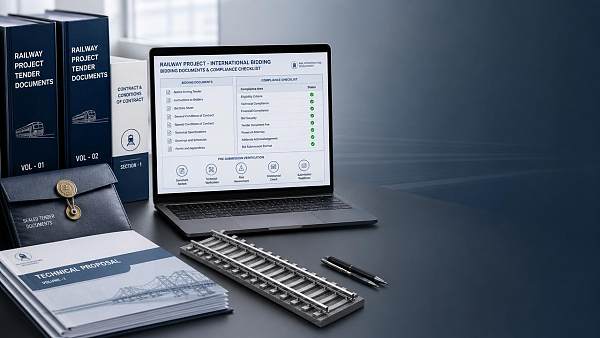
- Verify every mandatory instruction in the tender dossier, including signature rules, bid security format, submission sequence, language requirements, and deadline mechanics.
- Map all compliance obligations against contract conditions, employer requirements, local regulations, and referenced standards such as EN 50126, IEC 62278, or ISO/TS 22163.
- Cross-check legal entity details across forms, certificates, powers of attorney, tax records, parent guarantees, and consortium agreements to eliminate administrative contradiction.
- Confirm that financial statements, turnover thresholds, bonding capacity, and insurance evidence match the qualification criteria exactly, not approximately.
- Align technical narratives with commercial assumptions so delivery schedules, spare parts coverage, testing scope, and warranty obligations remain consistent throughout the bid.
- Review local content rules, origin declarations, customs exposure, and sanctioned-source restrictions before finalizing sourcing plans and supplier commitments.
- Test the risk allocation model by identifying uncapped liabilities, unrealistic performance damages, interface ambiguity, and acceptance conditions that can destroy margin later.
- Validate reference projects carefully, ensuring similar scope, contract value, system type, operating environment, and client certification evidence are available.
- Reconcile pricing tables, milestone logic, currency assumptions, escalation treatment, and provisional sums so no arithmetic or structural nonconformity appears.
- Run a red-team review that challenges exclusions, assumptions, deviations, and missing evidence before submission locks the commercial position.
Where rail project tenders usually fail first
Administrative non-responsiveness
The most common failure point is procedural, not technical. Missing seals, expired bid bonds, unsigned declarations, or incorrect file packaging can disqualify rail project tenders immediately. Evaluators often have no discretion to overlook formal defects.
Digital tender portals create another layer of risk. Upload limits, naming conventions, and timestamp rules can invalidate submissions. Even a complete proposal can fail if document indexing does not follow the prescribed structure.
Compliance mismatches across annexes
Large rail bids are often assembled by separate teams. Legal, engineering, and finance sections may each be correct in isolation, yet inconsistent as a package. One annex may offer a 24-month warranty, while another prices 18 months.
This inconsistency damages credibility and can be treated as a qualification failure. In regulated rail project tenders, internal contradiction suggests poor execution control and weak contract readiness.
Unclear risk acceptance
Many bids try to stay competitive by remaining silent on difficult clauses. That approach backfires when the tender requires explicit acceptance of liquidated damages, interface responsibility, RAMS obligations, or testing liability.
If the bid appears conditional, non-committal, or commercially evasive, it may be ruled non-responsive. Rail project tenders succeed when risk positions are deliberate, documented, and aligned with the pricing strategy.
Scenario-based application across the rail value chain
High-speed rail systems
In HSR procurement, interface precision is critical. Rolling stock, traction power, signaling, and platform systems must connect under strict safety and timetable assumptions. Rail project tenders often fail when interface ownership is vague or split across suppliers without governing logic.
Evidence also matters more than claims. Stated speed capability or bogie performance is insufficient without certification records, test references, and traceable compliance documentation.
Urban metro and transit
Metro tenders usually emphasize lifecycle availability, maintainability, depot integration, and operating headway. Early failure occurs when bids focus heavily on equipment features but understate maintainability planning, spare strategy, and service support commitments.
Urban rail project tenders also face local content pressure. If assembly, training, or after-sales obligations are not translated into credible execution plans, the bid may lose standing before deep technical comparison.
Signaling and communication packages
CBTC, ETCS, and telecom packages are highly sensitive to software assurance, cybersecurity, safety case structure, and migration planning. A bidder may have strong technology, yet fail early if software baseline control or assurance methodology is poorly described.
For these rail project tenders, evaluators expect disciplined traceability between functional requirements, hazard management, verification matrices, and commissioning responsibilities.
Commonly overlooked risk items
- Parent company support language may be weaker than tender conditions, creating a qualification gap even when the balance sheet is strong.
- Named subcontractors may lack finalized commitment letters, exposing the bid to credibility concerns on critical delivery scope.
- Reference projects may not match required operating conditions, such as axle load, climate zone, interoperability framework, or signaling architecture.
- Deviation logs may omit commercial assumptions already embedded in pricing, leaving evaluators to discover hidden conditions later.
- Factory acceptance, site acceptance, and reliability demonstration requirements may be acknowledged superficially without costed execution logic.
These issues are often small in appearance but decisive in outcome. Rail project tenders are usually judged by cumulative confidence, not isolated claims. Every unresolved inconsistency lowers confidence in project delivery reliability.
Practical execution steps to improve bid survival
Start with a compliance matrix owned jointly by legal, commercial, and technical leads. Every tender clause should have one accountable response, one supporting document source, and one final reviewer.
Build a bid logic map before drafting. Link qualification evidence, standards compliance, delivery milestones, interface assumptions, and pricing basis. This prevents contradictions that often sink rail project tenders before technical review.
Stress-test contract terms using scenario review. Model schedule delay, test failure, customs disruption, and subsystem interface disputes. If the economics collapse under probable stress, the bid position needs revision before submission.
Use an independent final audit. A fresh reviewer should inspect signatures, document versioning, annex numbering, bid bond wording, and portal upload order. Administrative precision remains one of the cheapest ways to improve tender success.
Conclusion and next action
Rail project tenders do not usually fail early because the engineering is impossible. They fail because the submission is misaligned with procurement rules, risk expectations, evidence standards, and commercial coherence. In a regulated infrastructure market, early-stage responsiveness is a competitive capability in its own right.
The next step is simple: audit the current bid process against a structured pre-submission checklist. Review compliance, documentation, pricing logic, risk acceptance, and reference validity before technical content is finalized. Stronger discipline at this stage gives rail project tenders a far better chance of reaching the evaluation phase where engineering strength can actually be judged.
Search News
Industry Portal
Hot Articles

Popular Tags
Recommended News
 May 20, 2026Why rail data transparency now shapes safer asset decisionsRail data transparency is reshaping safer rail asset decisions with traceable evidence, lifecycle insight, and stronger supplier confidence across complex transit projects.
 May 19, 2026How rail data transparency changes risk across projectsRail data transparency helps rail projects reduce hidden risk, improve compliance, and strengthen supplier visibility. See the checklist that supports safer delivery and smarter lifecycle decisions.
 May 19, 2026Why rail engineering integrity fails long before faults showRail engineering integrity often weakens long before visible faults appear. Discover scenario-based risks, early warning signs, and practical actions to reduce failures, costs, and compliance exposure.
 May 18, 2026How rail technical specifications reduce compliance mistakesRail technical specifications help rail teams reduce compliance mistakes, improve traceability, and align design, sourcing, testing, and installation for safer, faster project delivery.
 May 18, 2026What rail market analysis reveals before expansion plansRail market analysis reveals demand, supplier readiness, compliance, and lifecycle risks before expansion. See how scenario-based insights improve rail investment decisions.
 May 18, 2026How rail technical standards shape safer system upgradesRail technical standards guide safer rail upgrades by improving compliance, reducing integration risk, and strengthening procurement decisions. Learn how to evaluate suppliers and systems with confidence.
 May 17, 2026Why rail project tenders fail before technical reviewRail project tenders often fail before technical review due to compliance gaps, bid errors, and weak risk framing. Learn the key checks that improve bid survival and win rates.
 May 17, 2026How rail European standards affect project approval pathsRail European standards shape approval paths, timelines, and supplier risk in cross-border rail projects. Discover key compliance factors to evaluate bids and enter the market with confidence.
 May 16, 2026What rail economic resilience means for long term budgetsRail economic resilience helps financial approvers reduce long-term budget risk, improve lifecycle value, and make smarter rail investment decisions with greater confidence.
 May 16, 2026Why rail policy foresight now matters more in network planningRail policy foresight is now critical to network planning. Discover a practical checklist to reduce compliance risk, protect funding, and build resilient rail corridors.
 May 16, 2026What makes a rail commercial gateway worth the investmentRail commercial gateway value starts with verified benchmarks, compliance insight, and supply-chain clarity—discover what makes the investment smarter for rail decisions.
 May 15, 2026What Rail Benchmarking Really Shows Beyond Headline KPIsRail benchmarking goes beyond headline KPIs to reveal lifecycle risk, compliance gaps, and vendor resilience—helping rail leaders compare systems smarter and invest with confidence.
 May 15, 2026Why Some Rail Project Tenders Attract Fewer Qualified BidsRail project tenders often attract fewer qualified bids due to restrictive specs, unclear risks, and heavy compliance. Discover practical fixes to improve competition and delivery outcomes.
 May 15, 2026How EPC Rail Contractors Are Being Shortlisted TodayEPC rail contractors are now shortlisted by delivery record, compliance, systems integration, and supply chain strength. Learn the key criteria shaping better rail procurement decisions.
 May 14, 2026Rail Intelligence Is Expanding Fast, but Which Data Matters?Rail intelligence is growing fast, but only verified, decision-ready data drives results. Discover which benchmarks, standards, and market signals matter most for smarter rail opportunities.
 May 14, 2026How EPC Rail Contractors Are Being Evaluated DifferentlyEPC rail contractors are now judged on compliance, digital maturity, lifecycle reliability, and cross-border delivery—not just price. Learn what buyers value most today.
 May 13, 2026Can rail economic resilience reduce lifecycle budget shocks?Rail economic resilience helps financial approvers reduce lifecycle budget shocks, improve funding confidence, and make smarter rail investment decisions with data-backed cost stability.
 May 12, 2026Rail Technical Specifications That Often Break Projects LateRail technical specifications often trigger late rail project delays through hidden gaps in interfaces, compliance, and testing. See the critical risks and how to prevent costly rework.
 May 11, 2026Rail project tenders often fail on these bid compliance pointsRail project tenders often fail on bid compliance, not price. Learn the key gaps in standards, RAMS, testing, and document control to improve win rates.
 May 11, 2026EPC rail contractors: what causes cost overruns most oftenEPC rail contractors face cost overruns most often from scope changes, approval delays, and interface risk. Learn the key warning signs and how to control budget exposure early.
 May 11, 2026What separates rail Tier-1 suppliers from the rest?Rail Tier-1 suppliers stand out through engineering depth, compliance readiness, and lifecycle support. Learn how to compare vendors, reduce risk, and choose partners with confidence.
 May 09, 2026When rail commercial gateway strategy starts hurting marginsRail commercial gateway growth can boost rail market access, but rising compliance, layered channels, and hidden support costs can crush margins. Learn how to protect profit and scale smarter.
 May 09, 2026Can rail data transparency reduce delays in fault tracing?Rail data transparency can cut fault-tracing delays by linking logs, maintenance history, and asset data. See how rail teams speed diagnosis and prevent repeat failures.
![]() May 08, 2026Rail Benchmarking Can Mislead If You Compare the Wrong MetricsRail benchmarking can mislead when teams compare the wrong metrics. Learn how to assess lifecycle cost, compliance, and real-world performance for smarter rail decisions.
May 08, 2026Rail Benchmarking Can Mislead If You Compare the Wrong MetricsRail benchmarking can mislead when teams compare the wrong metrics. Learn how to assess lifecycle cost, compliance, and real-world performance for smarter rail decisions.



















Quarterly Executive Summaries Delivered Directly.
Join 50,000+ industry leaders who receive our proprietary market analysis and policy outlooks before they hit the public library.