

Pantograph tech choices affect more than current collection
Dr. Alistair Thorne
Time
Click Count
Pantograph technology decisions are rarely just about getting power from the overhead line. In practice, they affect fleet reliability, contact wire wear, energy efficiency, maintenance intervals, speed capability, noise performance, and even how easily a project can satisfy regional rail standards. For procurement teams, technical evaluators, EPC contractors, and channel partners, the key question is not simply “which pantograph is better,” but “which pantograph architecture creates the best whole-life outcome for this specific rail application?”
That is especially important in today’s market, where high-speed rail, urban metro systems, and cross-border rolling stock programs face tighter performance expectations, stricter compliance requirements, and stronger pressure to reduce lifecycle cost. A pantograph that looks acceptable on a datasheet can still create downstream problems in current collection stability, carbon strip wear, electromagnetic compatibility, or traction power system interaction. Choosing correctly means evaluating the pantograph as part of the wider rail system—not as an isolated component.
What decision-makers are really trying to understand when they assess pantograph technology
When readers search for insights on how pantograph tech choices affect more than current collection, they are usually looking for a practical framework for decision-making. They want to know how pantograph selection influences operational reliability, infrastructure compatibility, maintenance burden, and project risk. In other words, the intent is highly evaluative rather than purely educational.
For technical assessment teams, the concern is whether a specific pantograph can maintain stable contact under the operating envelope of the train, including speed, wind, tunnel entry, temperature variation, and line geometry. For business evaluators and procurement directors, the concern expands to total cost of ownership, vendor maturity, spare parts continuity, certification risk, and whether the product can support long-term fleet performance targets.
Distributors and commercial intermediaries often have a further concern: how to position a pantograph solution in different markets. A design that performs well in one region may face approval hurdles or infrastructure mismatches in another. This is why the most useful content is not a generic component overview, but a system-level explanation of trade-offs.
Why pantograph choice directly affects rolling stock reliability
Rolling stock reliability is one of the clearest areas where pantograph selection has a wider impact. If the pantograph does not maintain consistent contact force with the overhead contact line, the result can be arcing, uneven wear, transient power interruptions, and accelerated damage to both onboard and wayside assets. These issues may appear initially as minor current collection disturbances, but over time they can contribute to traction faults, unscheduled maintenance, and service disruption.
Several design variables shape this outcome:
- Contact force control: Too low, and the pantograph risks loss of contact and arcing. Too high, and it increases mechanical wear on the contact wire and strip.
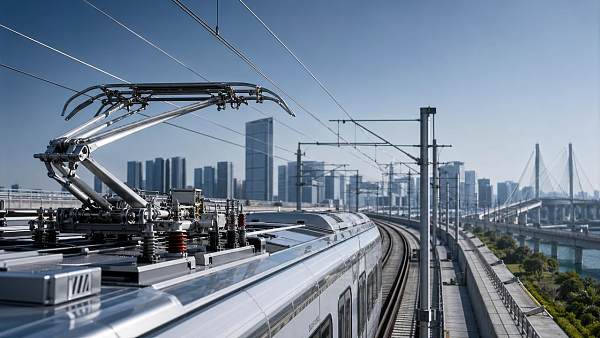
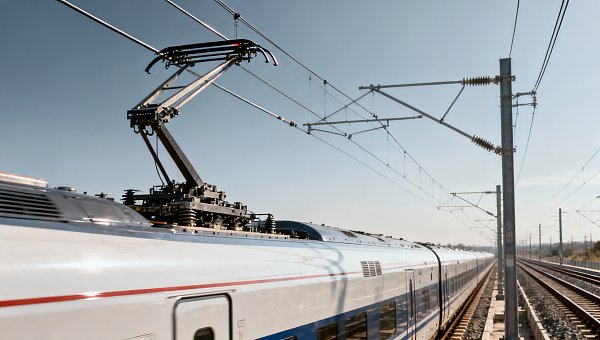
- Head geometry and aerodynamic behavior: At higher speeds, airflow can destabilize the pantograph. Aerodynamic optimization becomes critical for high-speed rail applications.
- Structural stiffness and damping: The pantograph must respond to line irregularities without introducing excessive oscillation.
- Carbon strip material and wear profile: Material choice affects conductivity, wear rate, maintenance intervals, and interaction with the catenary.
- Raising and lowering mechanism reliability: Faults in actuation can disable a vehicle or reduce operational flexibility.
In urban metro environments, where stop-start cycles are frequent and service punctuality is tightly measured, pantograph reliability influences daily availability. In high-speed rail, where dynamic interaction with the catenary becomes more complex, the consequences of poor choice are even greater. The wrong technology can reduce stable operating speed margins and increase maintenance interventions across the fleet.
How pantograph performance influences traction power quality and system efficiency
Pantographs are part of the traction power chain, so their design affects more than mechanical contact. Stable current collection contributes to better traction power quality, fewer transient disturbances, and more efficient power transfer. This matters for both network operators and train builders because a poorly matched pantograph can increase energy loss, contribute to electrical noise, and create stress in downstream electrical equipment.
Key impacts include:
- Reduced arcing and electrical instability: Better contact dynamics help protect onboard high-voltage equipment and reduce wear on the overhead line.
- Improved compatibility with modern traction systems: Advanced trains with high-performance converters and regenerative braking need dependable current collection behavior.
- Better system efficiency: Stable contact reduces avoidable losses and supports smoother power delivery.
- Lower infrastructure stress: A well-matched pantograph reduces cumulative damage to catenary components and extends asset life.
This is especially relevant in networks with dense service patterns, mixed rolling stock, or ambitious carbon-neutral rail targets. If the pantograph contributes to unnecessary wear or electrical disturbance, that inefficiency eventually appears in maintenance budgets, asset renewal cycles, and service quality metrics.
High-speed rail and metro systems do not need the same pantograph strategy
One common procurement mistake is evaluating pantographs using broad assumptions instead of application-specific criteria. High-speed rail and urban metro systems operate under very different conditions, so the “best” pantograph depends on the duty profile.
For high-speed rail, priorities typically include aerodynamic stability, low uplift variation, robust dynamic response at very high speed, and close compatibility with the catenary design. The margin for error is smaller, because dynamic effects increase sharply with speed. Certification and interoperability considerations also become more important, especially in cross-border or internationally benchmarked projects.
For urban metro transit, the emphasis is often on reliability under frequent acceleration and braking, compact integration, ease of maintenance, cost-effective spare parts strategy, and strong performance in tunnels, depots, and constrained urban infrastructure. Durability under repeated daily cycles may matter more than extreme speed performance.
For regional and intercity fleets, decision-makers may need a balanced solution that supports varied infrastructure conditions, moderate-to-high operating speeds, and lower lifecycle cost without over-specifying the system.
The practical takeaway is simple: pantograph technology should be matched to route characteristics, rolling stock architecture, maintenance model, and infrastructure standard—not selected through a one-size-fits-all template.
Compliance risk is a major reason pantograph selection deserves more scrutiny
In international rail projects, compliance is often where component decisions become commercially critical. A pantograph may be technically capable, but if it creates uncertainty in certification, testing, or infrastructure compatibility, it can delay approvals, increase project costs, or limit market access.
For stakeholders working across Europe, North America, the Middle East, and Asia, pantograph evaluation should consider the relevant technical and safety frameworks governing rolling stock integration, electromagnetic behavior, current collection performance, and lifecycle reliability. Depending on project scope, this may involve alignment with standards and processes related to system assurance, RAMS expectations, and rolling stock interoperability.
The risk areas usually include:
- Interface mismatch with overhead line parameters
- Inadequate validation under operating speed and environmental conditions
- Insufficient documentation for certification or customer acceptance
- Weak traceability in manufacturing quality systems
- Unclear maintenance and replacement specifications
For procurement directors and EPC teams, this means pantograph sourcing cannot be based on unit price alone. A lower-cost component with higher compliance uncertainty may be far more expensive at project level if it creates testing delays, redesign work, or operator resistance.
What technical evaluators should compare beyond the product datasheet
Datasheets are necessary, but they rarely tell the full story. To make a sound technical assessment, teams should compare pantograph solutions using both component-level and system-level criteria.
A stronger evaluation framework includes the following questions:
- Dynamic performance: How stable is current collection across the full speed range and under realistic infrastructure conditions?
- Infrastructure interaction: How does the pantograph affect contact wire wear, uplift, and long-term catenary maintenance?
- Environmental adaptability: Can it perform consistently in crosswind, dust, humidity, icing, or temperature extremes?
- Maintenance accessibility: How easy is it to inspect, replace strips, service actuators, and manage spare parts?
- Lifecycle evidence: Is there proven field performance on comparable fleets or routes?
- Supplier quality maturity: Does the manufacturer demonstrate traceable quality assurance and reliable after-sales support?
- Integration burden: Will the pantograph require significant redesign in the vehicle roof layout, electrical interface, or control logic?
This kind of comparison helps technical teams move from theoretical suitability to deployment confidence. It also gives business evaluators a clearer basis for judging risk-adjusted value.
How pantograph choices affect total cost of ownership
For commercial and project leaders, the most important insight is that pantograph decisions often shift cost from procurement to operations and maintenance. A cheaper unit may increase strip replacement frequency, contact wire wear, labor requirements, or fault-related downtime. A higher-quality solution may cost more upfront, but lower total expenditure across the asset lifecycle.
Total cost of ownership typically includes:
- Initial purchase and integration cost
- Testing and certification cost
- Maintenance labor and replacement intervals
- Spare parts inventory and supply continuity
- Impact on overhead line maintenance
- Service disruption risk and fleet availability loss
- End-of-life replacement planning
In large rail transit programs, even small differences in wear rate or failure frequency can produce major long-term financial consequences. This is why leading buyers increasingly view pantographs as strategic reliability components rather than commodity hardware.
A practical selection approach for procurement, EPC, and channel teams
If the goal is to make a defensible pantograph choice, a structured process works better than a feature checklist. A useful approach is:
- Define the operating envelope — speed, voltage system, route geometry, climate, tunnel profile, and service frequency.
- Map infrastructure compatibility — catenary characteristics, maintenance practices, and network-specific constraints.
- Prioritize project outcomes — reliability, low wire wear, fast approval, lower maintenance, or export-market compliance.
- Compare supplier evidence — testing data, installed references, quality certifications, and after-sales capability.
- Model lifecycle cost — not just acquisition cost, but wear, downtime, service intervals, and infrastructure impact.
- Review compliance readiness — documentation, validation records, and fit with applicable rail standards.
- Plan long-term support — spare parts, technical training, local service, and upgrade path.
For distributors and agents, this framework also helps identify which manufacturers are best suited for specific markets. The strongest product is not always the one with the highest headline performance, but the one with the best alignment to local infrastructure, regulatory expectations, and operator priorities.
Conclusion: pantograph technology should be judged by system impact, not component cost alone
Pantograph tech choices affect far more than current collection. They influence rolling stock reliability, traction power stability, infrastructure wear, compliance complexity, maintenance workload, and long-term project economics. That is why serious evaluation must connect pantograph design to the realities of high-speed rail, metro transit, and cross-market deployment.
For information researchers, technical evaluators, business assessment teams, and channel partners, the most useful mindset is system-level thinking. The right pantograph is the one that supports reliable operation, fits the infrastructure, reduces lifecycle risk, and aligns with the regulatory and commercial demands of the target market. In rail projects where performance, safety, and asset longevity are tightly linked, pantograph selection is not a minor hardware decision—it is a strategic infrastructure decision.
Search News
Industry Portal
Hot Articles

Popular Tags
Recommended News
 May 01, 2026Rail Market Analysis Signals a Shift in Pantograph DemandRail market analysis reveals why pantograph demand is shifting across high-speed, metro, and retrofit projects—explore buyer trends, sourcing risks, and growth opportunities.
 Apr 23, 2026Pantograph tech choices affect more than current collectionPantograph tech shapes rolling stock reliability, traction power, rail standards compliance, and predictive maintenance. Learn how smarter choices improve urban metro and high-speed rail lifecycle performance.
Quarterly Executive Summaries Delivered Directly.
Join 50,000+ industry leaders who receive our proprietary market analysis and policy outlooks before they hit the public library.